New: Open crowdsourced list of Society Journals

Unpaywall Journals needed data on whether a given journal is associated with an academic society, to help inform librarians in their subscription decisions. Alas there was no open source of this information.

There is now! Thanks to 60+ contributors over the last week, all Elsevier and Wiley journals have now been annotated with whether or not they are a society journal. Many also have the society name itself listed in the notes.

We are releasing this dataset CC0 in its Google Spreadsheet now, and will clean it up and host it in a stand-alone API endpoint in the coming weeks. It has already been pulled into Wikidata! Others are welcome and encouraged to use it however they’d like 🙂

Thanks so much to all of these contributors, some of whom annotated hundreds of journals:

  • Lauren Maggio
  • Eamon Costello
  • Hugo Gruson
  • Heather K Moberly
  • Sofie Wennström
  • josmel pacheco-mendoza
  • Kate O’Neill
  • Stefanie Haustein
  • Lisa Matthias
  • Kathryn Pelland
  • Camilla Lindelöw
  • Amanda Whitmire
  • Iara Vidal
  • Raquel Donahue
  • Sam Teplitzky
  • Steffi Grimm
  • Marianne Gauffriau
  • Anonymous Dinosaur Librarian (> 60 and still bringing it!)
  • Maximilian Heimstädt
  • Kendra K. Levine
  • Ranti Junus
  • Nicki Clarkson
  • KT Vaughan
  • Sarah Severson
  • Christie Hurrell
  • Philipp Zumstein
  • Lucy Carr Jones
  • Emma U.
  • Chris Rusbridge
  • Diana Wright
  • Biljana Kosanovic
  • Milica Sevkusic
  • Patricia Brennan
  • Emilio M Bruna
  • Bevan S Weir
  • Irene Barbers
  • Oskia Agirre
  • Sarah R. O. Santos
  • Olivier Pourret
  • Phil Gooch
  • Frédérique Bordignon
  • Jackie Proven
  • Tobias Steiner
  • Eleanor Colla
  • Aidy Weeks
  • George Matsumoto
  • Egon Willighagen
  • Rob Hooft
  • Iseult Lynch
  • Andrew Gray
  • Heather Lang
  • Ethan White
  • Sarah Steele Cabrera
  • Didier Torny
  • Bruce Caron
  • Eleta Exline
  • Teresa Schultz
  • Christy Caldwell
  • Richard Abdill
  • Anthony Hamzah
  • Marc Couture

This was a great community push, and it is all of ours, and we’re sure thankful.

Unpaywall Journals — helping librarians get more value from their serials budget

We’re thrilled to announce a new product:

Unpaywall Journals is a data dashboard that combines journal-level citations, downloads, Open Access statistics and more, to help librarians confidently manage their serials collections.

Learn more, join the announcement list, and help spread the word.

It’s going to be big.

Update: In May 2020 we changed the name of Unpaywall Journals to Unsub.

.

Green OA lag

Ok I know for maximum impact we should probably spread all these blog posts out over multiple days, but I’m way too eager to share — I think people interested in Green OA will be really interested in this, I know I am.

It’s from the supplementary information section of the preprint, Section 11.1:

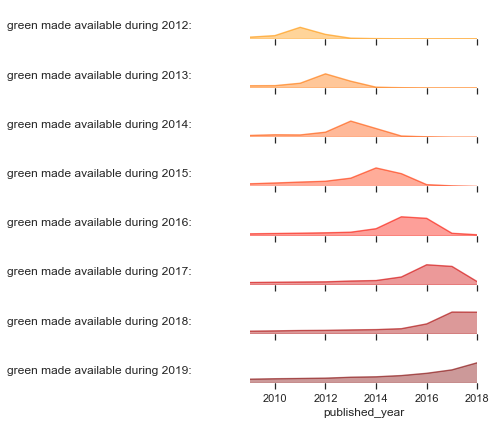
In the figure below we plot the number of Green OA papers made available each year vs their date of publication. The first plot is a histogram of number of papers made available each year (one row for each year).

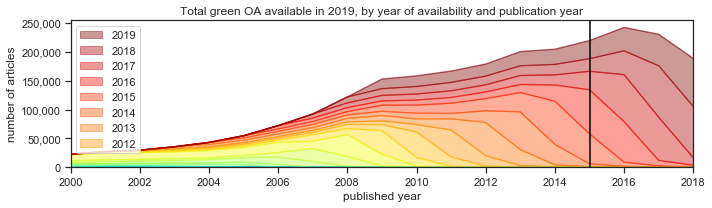
The next plot is the same, but superimposes the articles made available in previous years. This stacked area represents the total cumulative number of Green OA papers that are available in that year — if you were in that year and wondering what was available as Green OA that’s what you’d find.

The third plot is a larger version of the availability as of 2018, showing the accumulation of availability. It allows us to appreciate that less than half of papers papers published in, say, 2015, were made available the same year — most of the papers have been made available in subsequent years. The fourth plot is a slice in isolation, for clarity: the Green OA for articles with a Publication Date of 2015.

Again, this last plot is when articles that were published in 2015 were actually made available in repositories. As you can see at the bottom of the stacked bar, a very few articles that were published in 2015 were actually posted in a repository in 2014. Those are preprints. A lot of articles published in 2015 appeared in a repository in 2015, but even more had a delay and didn’t appear in a repository until 2016. A full 40% of articles had an OA lag of more than a year, including some with an OA lag of four years!

More details on data collection are in the paper — just wanted to dig this out of Supplementary Information so that fellow nerds who’d enjoy this data don’t miss it 🙂

The Future of OA: what did we find?

Here are some of the key findings from the recent preprint on the Future of OA:

  • By 2025 we predict that 70% of all article views will be to articles available as OA — only 30% of article view attempts will be to content available only via subscription.
    • This compares to 52% of views available as OA right now, so it’ll be a big change in the next five years.
  • The numbers of Green, Gold, and Hybrid articles have been growing exponentially, and growing faster than Delayed OA or Closed access articles:
    • articles by year of observation, with exponential best fit line:
  • The average Green, Gold, and Hybrid paper receives more views than its Closed or Bronze counterpart, particularly Green papers made available within a year of publication.
    • views per article, by age of article:
  • Most Green OA articles become OA within their first two years of publication, but there is a long tail.
    • articles made newly Green OA in each the last four years, histograms by year of publication:
  • One interesting realization from the modeling we’ve done is that when the proportion of papers that are OA increases, or when the OA lag decreases, the total number of views increase — the scholarly literature becomes more heavily viewed and thus more valuable to society. This is intuitive, but could be explored quantitatively in future work using this model or ones like it.

Anyway, there are more findings too, but those are some of the main ones.

New perspective for OA: Date of Observation

We’d like to share one of the fun parts of our recent preprint. It’s fun because the concept of Date of Observation helps to untangle issues around embargoes — and also because we think we came up with a neat way to explain what is otherwise a fairly complicated concept, and hopefully make it accessible to everybody.

See what you think — here is our description of the Date of Observation, from section 3.3 of the preprint:

Let’s imagine two observers, Alice (blue) and Bob (red), shown by the two stick figures at the top of the figure:

Alice lives at the end of Year 1–that’s her “Date Of Observation.” Looking down, she can see all 8 articles (represented by solid colored dots) published in Year 1, along with their access status: Gold OA, Green OA, or Closed. The Year of Publication for all eight of these articles is Year 1.

Alice likes reading articles, so she decides to read all eight Year 1 articles, one by one.

She starts with Article A. This article started its life early in the year as Closed. Later that year, though–after an OA Lag of about six months–Article A became Green OA as its author deposited a manuscript (the green circle) in their institutional repository. Now, at Alice’s Date of Observation, it’s open! Excellent. Since Alice is inclined toward organization, she puts Article A article in a stack of Green articles she’s keeping below.

Now let’s look at Bob. Bob lives in Alice’s future, in Year 3 (ie, his “Date of Observation” is Year 3). Like Alice, he’s happy to discover that Article A is open. He puts it in his stack of Green OA articles, which he’s further organized by date of their publication (it goes in the Year 1 stack).

Next, Alice and Bob come to Article B, which is a tricky one. Alice is sad: she can’t read the article, and places it in her Closed stack. Unbeknownst to poor Alice, she is a victim of OA Lag, since Article B will become OA in Year 2. By contrast, Bob, from his comfortable perch in the future, is able to read the article. He places it in his Green Year 1 stack. He now has two articles in this stack, since he’s found two Green OA articles in Year 1.

Finally, Alice and Bob both find Article C is closed, and place it in the closed stack for Year 1. We can model this behavior for a hypothetical reader at each year of observation, giving us their view on the world–and that’s exactly the approach we take in this paper.

Now, let’s say that Bob has decided he’s going to figure out what OA will look like in Year 4. He starts with Gold. This is easy, since Gold article are open immediately upon publication, and publication date is easy to find from article metadata. So, he figures out how many articles were Gold for Alice (1), how many in Year 2 (3), and how many in his own Year 3 (6). Then he computes percentages, and graphs them out using the stacked area chart at the bottom of the figure. From there, it’s easy to extrapolate forward a year.

For Green, he does the same thing–but he makes sure to account for OA Lag. Bob is trying to draw a picture of the world every year, as it appeared to the denizens of that world. He wants Alice’s world as it appeared to Alice, and the same for Year 2, and so on. So he includes OA Lag in his calculations for Green OA, in addition to publication year. Once he has a good picture from each Date Of Observation, and a good understanding of what the OA Lag looks like, he can once again extrapolate to find Year 4 numbers.

Bob is using the same approach we will use in this paper–although in practice, we will find it to be rather more complex, due to varying lengths of OA Lag, additional colors of OA, and a lack of stick figures.
The Future of OA: A large-scale analysis projecting Open Access publication and readership

We are excited to announce our most recent study has just been posted on bioRxiv:

Piwowar, Priem, Orr (2019) The Future of OA: A large-scale analysis projecting Open Access publication and readership. bioRxiv: https://doi.org/10.1101/795310

This is the largest, most comprehensive analysis ever to predict the future of Open Access. Importantly, we look not only at publication trends but also at *viewership* — what do people want to read, and how much of it is OA?

The abstract is included below, we’ll be highlighting a few of the cool findings in subsequent blog posts, and you can read the full paper here (DOI not resolving yet). All the raw data and code is available, as is our style: http://doi.org/10.5281/zenodo.3474007. Enjoy, and let us know what you think!


Understanding the growth of open access (OA) is important for deciding funder policy, subscription allocation, and infrastructure planning.

This study analyses the number of papers available as OA over time. The models includes both OA embargo data and the relative growth rates of different OA types over time, based on the OA status of 70 million journal articles published between 1950 and 2019.

The study also looks at article usage data, analyzing the proportion of views to OA articles vs views to articles which are closed access. Signal processing techniques are used to model how these viewership patterns change over time. Viewership data is based on 2.8 million uses of the Unpaywall browser extension in July 2019.

We found that Green, Gold, and Hybrid papers receive more views than their Closed or Bronze counterparts, particularly Green papers made available within a year of publication. We also found that the proportion of Green, Gold, and Hybrid articles is growing most quickly.

In 2019:

  • 31% of all journal articles are available as OA
  • 52% of all article views are to OA articles

Given existing trends, we estimate that by 2025:

  • 44% of all journal articles will be available as OA
  • 70% of all article views will be to OA articles

The declining relevance of closed access articles is likely to change the landscape of scholarly communication in the years to come.


Additional blog posts about this paper:

Impactstory is now Our Research

Big news: today Impactstory is changing our name! Meet: Our Research!

1. Why the change?

TL;DR we outgrew our old name and need a new one that fits broader scope of our work.

We’ve been passionate about Open Science from the beginning. That’s what we both researched as academics. And it’s what brought us together eight years ago, in the impromptu all-night hackathon where we built the first version of Impactstory Profiles. Open Science has been our passion through fast times and slow, fat times and lean. That’s Us.

Because of that we’ve jumped at chances to take on new Open Science infrastructure projects in the last eight years, projects like:

  • Unpaywall, an open index of the world’s Open Access papers,
  • Get The Research, a website to help regular people find, read, and understand research,
  • Depsy (and its yet-unnamed follow-up) to help show the impact of research software,
  • and we’ve got several new projects launching later this year (stay tuned :).

We’ve never seen these as distractions from our mission. We’ve seen them as our mission. And we’ve been thankful to have had the chance to work across several of the schools of Open Science. That’s going to continue as in coming months we leverage our new ability to fund projects with self-generated revenue. We’re thrilled at this.

However, it does mean that Impactstory name is becoming increasingly confusing. We love helping folks tell Stories about Impact…but that’s not all we do, and hasn’t been for a while now. So it’s time to change our name to reflect that.

2. Why the Our Research name?

TL;DR: “Research” means what it says. “Our” means we want research to belong to 1) humankind and 2) the academic community.

To answer that question more fully, let’s break the name down into its parts:

Research: The global Research enterprise is what we want to improve. And all research, not just Science (although we do suspect that the term “Open Science” is, while lamentably inaccurate, probably here to stay at this point). 

Our: Of course our is a possessive we. So who’s the “we” and what’s it possessing? There are two answers:

Most broadly we is…everyone. It’s every human who has ever woken up on this rock with a list of unanswered questions and unsolved problems and thought, hey let’s figure this out. Research is how we figure it out. The “our” is  possessive because (we believe) research belongs to to all of us, as humans. Knowing is a team sport. Our Research is dedicated to making our research knowledge more open and accessible to our species, because we’re all in this together.

More narrowly (and less grandiosely), we is the academic community: researchers, administrators, librarians, and everyone else working together to create all this new knowledge. We in the nonprofit academic world have our own way of looking at things, a perspective that’s quite different from the profit-driven priorities of the business world. Collaboration with for-profits can be valuable. But we (and lot of other folks)  don’t think for-profits should own our core scholarly infrastructure. We should. The scholarly community.  As a mission-driven nonprofit, Our Research works to build our research infrastructure in ways concordant with the shared values of our academic community. A lot of other folks feel the same.

3. What is Our Research trying to do?

TL;DR: we’re about what we’ve always been about: helping to bring about universal Open Science by building open, functional, sustainable infrastructure.

We felt like the new name was a good excuse to sit down and explicitly articulate our core values. There’s five. We value:

  • openness: We default to sharing. Our code is open-source and our data is open, too.
  • progress:  We seek revolution. We want to transform how scholars share, assess, and reuse research, moving beyond the paper to value all research products
  • community: We reach out. We’re proud to lead, proud to follow, and proud to work with anyone who shares our values. 
  • pragmatism:  We favor action over words. We make do with what we have, take what we can get. We ship.
  • sustainability: We’re not too proud or pure to hustle for cash–revolutions ain’t free. We’re now financially self-sustaining and aim to stay that way.

We’re so excited to move forward, guided by these values. We’ve got a lot to learn still, and a long long way to go before we reach our goals. But we’re bigger, better-funded, and more motivated than we’ve ever been. We are so, so thankful to everyone who has supported Impactstory for the last eight years. We hope that in the Our Research era we’ll make y’all proud. We’re sure gonna do our best. 

If you’d like to be notified about the cool stuff we’re launching later this year, sign up for our mailing list!

Welcome to our newest team member!

We’re excited to announce that we’ve added a new full-time employee to Impactstory. Richard Orr has joined us as the lead developer on Unpaywall. He’s fantastic, and has already made a big impact in the stability, performance, and feature set of Unpaywall–as well as massively improving the speed at which we address bugs. We are so excited about how much we’re going to be able to achieve now that Richard is on board!

He looks like this

By way of introduction, here’s a quick interview we did with Richard:

What drew you to this job?
The opportunity to contribute to science and make the world better. I’ve never had the required focus to become an expert in one field and make a big contribution in one area, so the chance to help everyone and make a small contribution in a lot of different areas was very appealing.

What will you be working on?
I’ll be working on Unpaywall, making it find more open access articles more accurately. I’ll also be making it work with other projects we have planned that will go beyond indexing articles by DOI and help you discover research in other ways.

What’s a time you’ve tried to find free-to-read scholarly literature for your own use?
Reading actual reviewed computer science papers has been extremely helpful in personal projects involving GPU computing. As a non-researcher it’s easy to forget that not everything is on Stack Overflow. With medical issues, I like to read relevant research myself so I know what questions to ask to make the best use of time during office visits. Plus, doctors love it when you quote studies to them. I highly recommend it.

What do you see as the biggest challenges in this job? Biggest opportunities?
Unpaywall takes a lot of data sources with wildly varying degrees of organization and completeness and aims to provide a reliable dataset that lets many types of users access them in a uniform way. Systems that implement clean interfaces to the messy and unpredictable human world are always challenging to master. As usual the challenge implies the opportunity, in that if we do it right we can spare a lot of people this work.

If you were stranded on a desert island with any researcher (miraculously raised from the dead if needed), who would it be and why?
Carl Sagan. I don’t think this needs justification.


We are so thrilled and excited to be adding Richard to our team. We decided early on that we only wanted to work with fantastic people, and Richard definitely fits the bill. With Richard’s help, we’re going to be releasing some pretty exciting stuff this year. Can’t wait to show y’all!

PS this post is actually going up pretty late, since Richard joined us in December 2018, but better late than never….

Introducing a new browser extension to make the paywall great again

It’s pretty clear at this point that open access is winning. Of course, the percentage of papers available as OA has been climbing steadily for years. But now on top of this, bold new mandates like Plan S are poised to fast-track the transition to universal open access.

But–and this may seem weird coming from the makers of Unpaywall–are we going too far, too fast? Sure, OA will accelerate discovery, help democratize knowledge, and whatnot. It’s obvious what we have to gain.

Maybe what’s less obvious is what we’re going to lose. We’re going to lose the paywall. And with it, maybe we’re going to lose a little something…of ourselves.

Think about it: some of humankind’s greatest achievements have been walls. You’ve got the Great Wall of China (useful for being seen from space!), the Berlin Wall (useful for being a tourist attraction!), and American levees (useful for driving your Chevy to, when they don’t break!)

Now, are the paywalls around research articles really great cultural achievements? With all due respect: what a fantastically stupid question. Of course they are! Or not! Who knows! It doesn’t matter. What matters is that losing the paywall means change, and that means it’s scary and probably bad.

Why, just the other day we went to read an scholarly article, and we wanted to pay someone money, and THERE WAS NOWHERE TO DO IT. Open Access took that away from us. We were not consulted. This is “progress?”

You used to know where you stood. Specifically, you stood on the other side of a towering paywall that kept you from accessing the research literature. But now: who knows? Who knows?

Well, good news friend: with our new browser extension, you know. That’s right, we are gonna make the paywall great again, with a new browser extension that magically erects a paywall to keep you from reading Open Access articles!

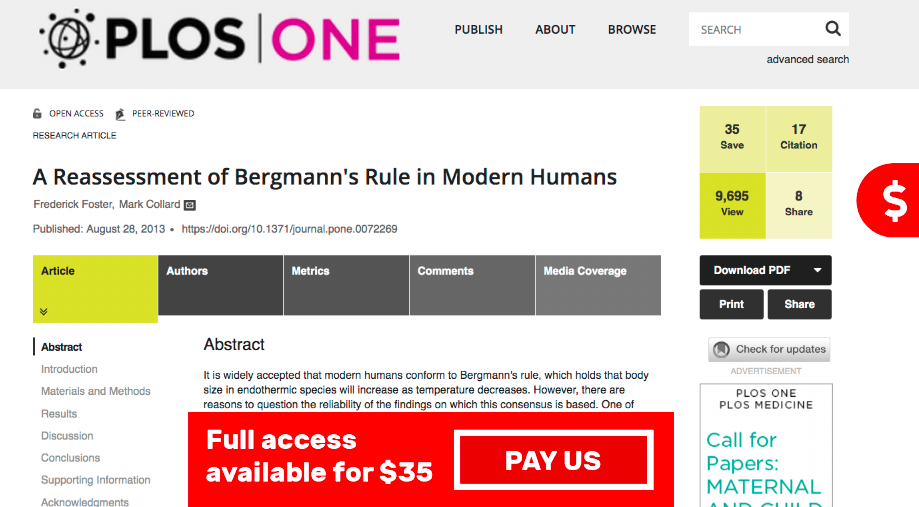
The extension is called Paywall (natch), and it’s elegantly simple: the next time you stumble upon one of those yucky open access articles, Paywall automatically hides it from you, and requires you pay $35 to read. That’s right, we’re gonna rebuild the paywall, and we’re gonna make you pay for it!

With Paywall, you’ll enjoy your reading so much more…after all, you paid $35 for that article so you better like it. And let’s be honest, you were probably gonna blow that money on something useless anyway. This way, at least you know you’re helping make the world a better place, particularly the part of the world that is our Cayman Islands bank account.

Paywalls are part of our heritage as researchers. They feel right. They are time-tested. They are, starting now, personally lucrative for the writers of this blog post. I mean, what more reasons do we need? BUILD. THE. WALL. Install Paywall. Now. Do it. Do it now.

Thanks so much for your continued support. Remember, we can’t stop the march of progress–but together, scratching and clawing and biting as one, maybe we can maybe slow it down a little. At least long enough to make a few extra bucks.

⇨ Click here to install Paywall!

~~~~~~~~~

Podcast episode about Unpaywall


I recently had a fun conversation with @ORION_opensci for their just-launched podcast.

The episode is about half an hour long, and covers what @Unpaywall is, who uses it, how it came about, a bit about how it works, thoughts on the importance of #openinfrastructure, the sustainability model, how open jives with getting money from Elsevier, #PlanS, how to help the #openscience revolution…

Anyway, here’s where you can listen (you can either load it into your Podcast app, or just press “play” on the webpage player):

https://orionopenscience.podbean.com/e/scaling-the-paywall-how-unpaywall-improved-open-access/

(Or here’s the MP3.)

Thanks for having me @OOSP_ORIONPod, it was super fun!  And do check out the rest of the episodes as well, they are covering great topics: